Fixed vs Floating Interest Rates on Home Loans: Which Is Better?
Buying a house is one of the largest financial transactions that people undertake. Although making the correct choice in terms of the house is an important step, choosing the right mortgage is also important. One such choice that often perplexes many people is that between a fixed and floating interest rate.
Understanding fixed vs floating interest rates can help you handle your payments better. Rupeeco provides assistance to borrowers to choose a mortgage that would suit their salary and repayment capability. Let's find out how the two types operate.
What Are Fixed vs Floating Interest Rates?
The rate of interest that is charged by the bank on the money that you borrow for your house will have an impact on the additional amount that you must repay along with the principal amount of the loan.
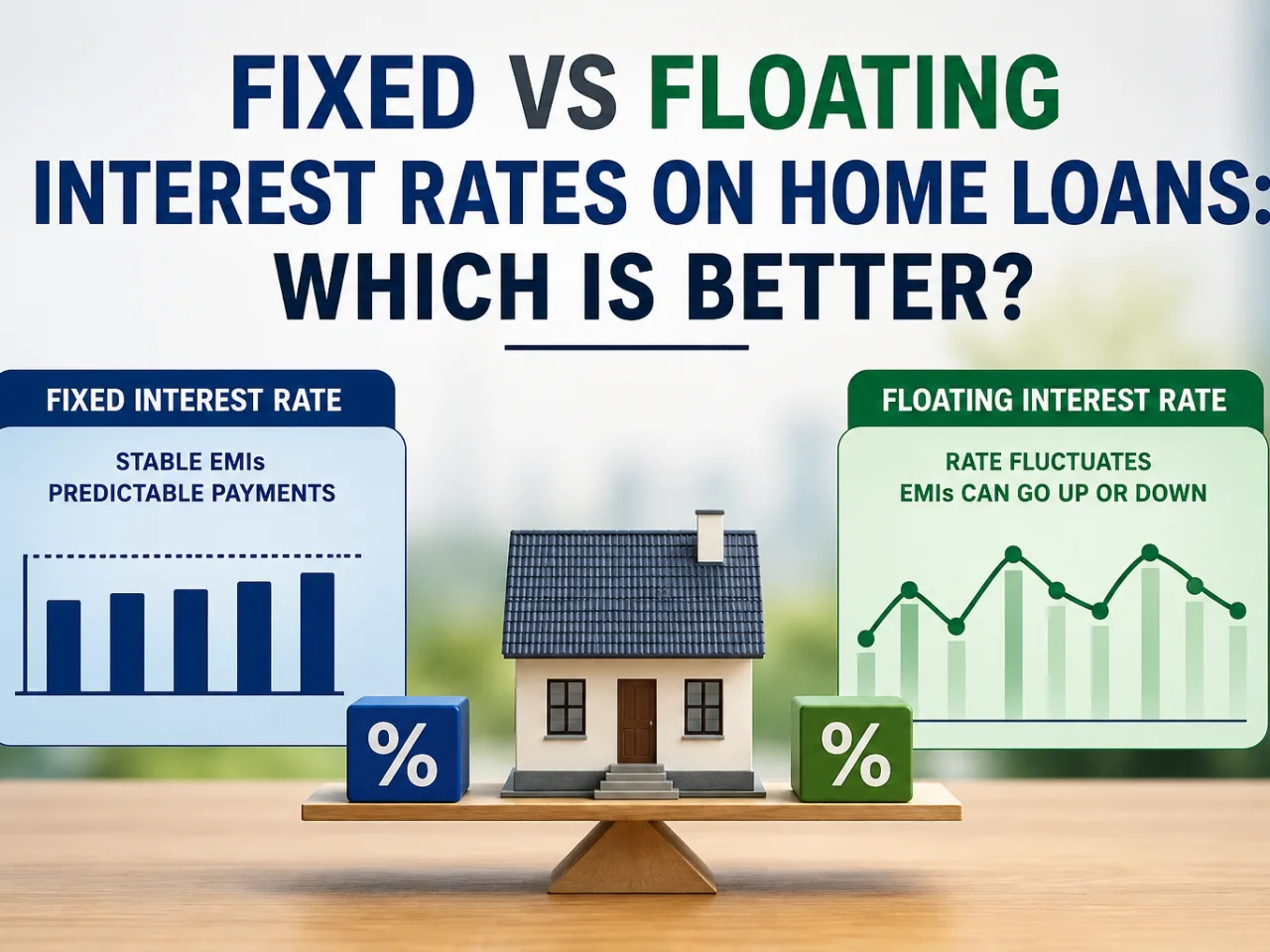
A fixed interest rate is meant to offer more certainty, while a floating interest rate varies depending upon the benchmark set by the lending institution.
When choosing between fixed and floating interest rates, there are certain factors that need to be kept in mind, like your financial stability and EMIs.
How Fixed Rates Work on Home Loans
Understanding how fixed rates work is relatively simple. Under a fixed-rate arrangement, the applicable interest rate remains fixed for the period specified by the lender.
This provides greater certainty about your repayment obligations.
Benefits of a Fixed Interest Rate
- Better forecasts on loan payments
- Easier monthly budgets
- Avoidance of rising interest rates during the fixed rate period
- Appropriate for individuals who are more concerned with stability of their loan payments
However, fixed-rate loans may sometimes be offered at a higher initial rate than comparable floating-rate options. Borrowers should also check whether the rate is fixed for the entire loan tenure or only for a specified period.
How Floating Rates Work on Home Loans
Now, let us understand how floating rates work.
A floating interest rate can move up or down based on the benchmark and reset terms applicable to your loan. Therefore, your borrowing cost may change during the loan tenure.
Benefits of a Floating Interest Rate
- Potential benefit when applicable lending rates decline
- Often competitive initial pricing
- Suitable for borrowers comfortable with changing repayment costs
- Can be useful for long-term borrowers who can manage rate fluctuations
The main consideration is uncertainty. If rates rise, your EMI or loan tenure may increase depending on the lender's terms.
Fixed vs Floating Interest Rates: Key Differences
Factor
Fixed Interest Rate
Floating Interest Rate
Rate movement
Fixed for the agreed period
Can increase or decrease
EMI predictability
Generally higher
Can vary
Budget planning
Easier
Requires flexibility
Benefit from falling rates
Usually limited
Potentially available
Risk from rising rates
Lower during fixed period
Higher
Suitable for
Stability-focused borrowers
Borrowers comfortable with fluctuations
Understanding these differences can make your home loan decision much easier.
Impact on EMI and Overall Loan Cost
Impact on EMI is the most significant consideration among the many when determining the home loan interest rate.
If you have a fixed interest rate, your payments will be more predictable in the time that the fixed interest rate applies. It might help you in maintaining a tight monthly budget.
In case of the floating interest rate, any changes in the applicable interest rate will impact your payment plan. The increment of the rate will lead to an increase in EMI, tenure, or both.
A minor difference in interest rates may make a great deal for a long-term home loan. That means that you should look at the overall cost of borrowing and not just EMI.
Use a Home Loan EMI Calculator Before Deciding
There is a tool to calculate home loan EMI that helps to calculate the repayments before taking out a loan.
Input information like:
- Amount of loan required
- Interest rate
- Duration of loan repayment period
This will allow you to explore different scenarios and how varying interest rates and duration will impact your financial planning.
At Rupeeco, it is advisable to calculate EMI on an affordable basis before availing home loans.
Check Your Home Loan Eligibility
The eligibility for your home loan may play a role in determining the amount that the lender might offer you.
Some of the parameters considered by lenders include the following:
- Monthly income
- Age
- Credit score and repayment history
- Stability of employment/business
- Current EMI and other obligations
- Property-specific parameters
Having a good financial standing can help you avail yourself of favourable home loan options. You should be financially prepared before making a home loan application.
Which Home Loan Rate Should You Choose?
So, Which Home Loan Rate Should You Choose?
There is no single answer that works for every borrower.
A fixed rate may be suitable if you value predictable repayments and want greater protection against rate increases during the fixed period.
A floating rate may be worth considering if you can comfortably manage fluctuations and want the potential benefit of declining lending rates.
Before making your decision, consider:
- Your monthly income and expenses
- EMI repayment capacity
- Loan tenure
- Existing financial commitments
- Current loan terms
- Your tolerance for changes in repayment costs
Rather than trying to predict future interest rates, choose an option that fits your financial situation.
How Rupeeco Can Help
At Rupeeco, we understand that comparing home loans can feel complicated. Interest rates, eligibility requirements, repayment terms, and lender conditions can vary significantly.
We help borrowers understand available home loan options, compare relevant terms, evaluate home loan eligibility, and make informed borrowing decisions.
Whether you are buying your first home or evaluating your existing housing finance, our goal is to make the process simpler and more transparent.
Conclusion
Fixed vs floating interest rates will depend on your financial objectives. Fixed interest rates give you surety regarding the repayment of a loan, whereas floating interest rates give you the flexibility as well as the opportunity to gain from falling applicable interest rates.
While making this decision, make sure you know the impact of EMI and your loan eligibility for a home loan, and also consider using the home loan EMI calculator.
At Rupeeco, we believe that the perfect home loan is not about the one with the lowest interest rate. It is about the loan which suits you financially.
FAQs
1. What is the main difference between fixed and floating interest rates?
A fixed interest rate remains unchanged for the period specified by the lender, providing predictable repayments. A floating interest rate can increase or decrease based on the applicable benchmark and the lender's reset terms.
2. Which is better: a fixed or floating interest rate for a home loan?
There is no single option that is best for everyone. A fixed rate may suit borrowers who prefer predictable EMIs, while a floating rate may suit those who are comfortable with fluctuations and want the potential benefit of falling interest rates.
3. How do fixed and floating interest rates impact home loan EMI?
The impact on EMI depends on the type of interest rate. Fixed rates generally provide stable repayments during the fixed period. With floating rates, changes in the applicable interest rate may affect your EMI, loan tenure, or both.
4. Can I switch from a fixed to a floating interest rate later?
Some lenders allow borrowers to switch between fixed and floating interest rates. However, conversion fees, eligibility conditions, and other charges may apply. Check your lender's terms before requesting a switch.
5. How can a home loan EMI calculator help me choose?
A home loan EMI calculator lets you compare estimated repayments using different loan amounts, interest rates, and tenures. This can help you understand which repayment structure is more comfortable for your budget.
6. Does home loan eligibility change for fixed and floating rates?
Your home loan eligibility is primarily determined by factors such as income, credit history, age, existing liabilities, repayment capacity, and property details. However, the lender's applicable rate and EMI calculation can influence the loan amount you may qualify for.